
 Register

In the language of contemporary urban art, Invader occupies a unique position. His “invasion” is not merely a sequence of interventions scattered across city walls, but a complex and coherent project that combines aesthetic research, collective play, and reflection on the relationship between the real and the virtual.
Behind every small mosaic, behind every pixelated creature, lies a precise strategy that has turned the French artist into a global icon.
Mosaic as Analog Pixel
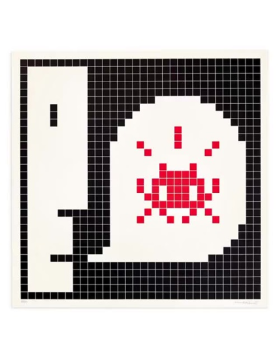
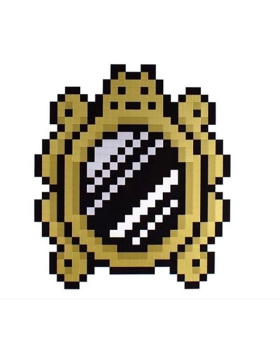
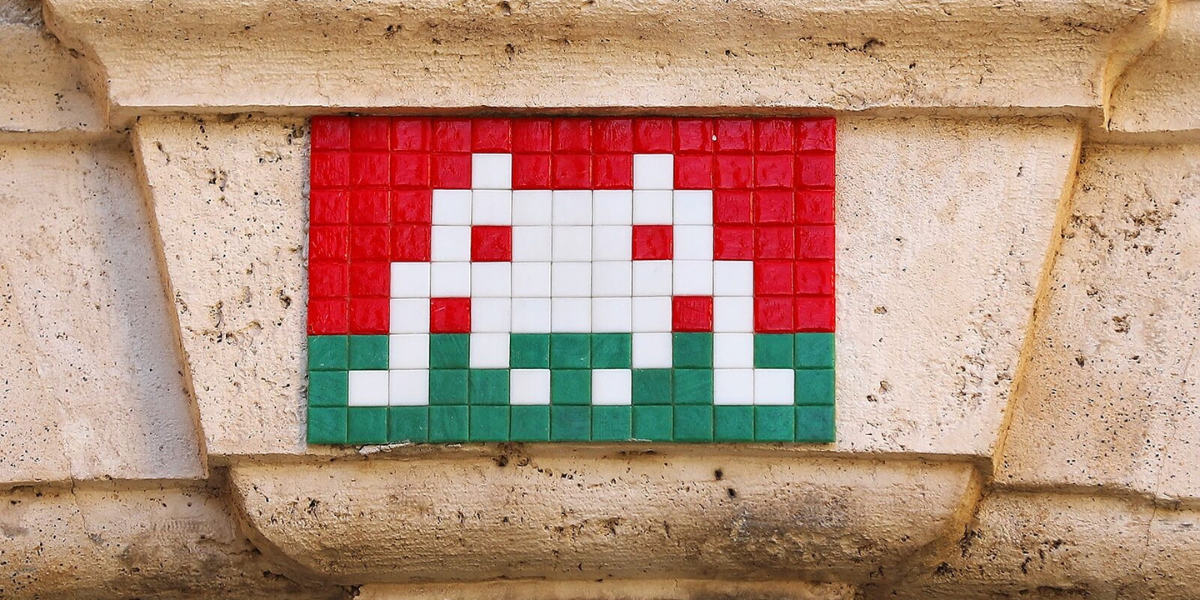
At the heart of Invader’s poetics is the mosaic. Using colored ceramic tiles, the artist reconstructs figures inspired by 1980s video games, reproducing the aesthetics of pixel art in a tangible form.
These mosaics, durable and versatile, are placed in unexpected locations: forgotten corners, monumental façades, underpasses, and peripheral neighborhoods. The choice of mosaic is deliberate: the material’s durability challenges time and removal, while the modular grid becomes a symbol of our digital culture.
Rubikcubism: The Cube as Brush
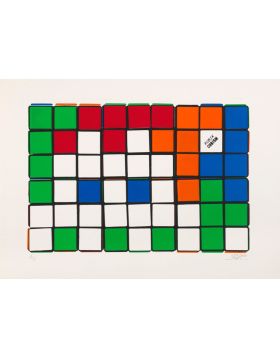
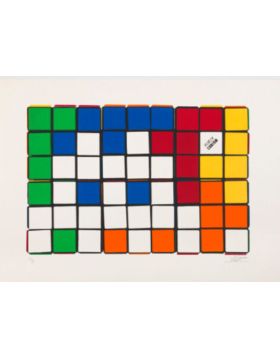
In parallel, Invader invented a technique that brings the concept of pixel art into three dimensions: “Rubikcubism.” Using dozens or even hundreds of Rubik’s Cubes, the artist arranges them to reconstruct iconic images: celebrity faces, classical artworks, historical photographs.
The game becomes painting material, and the mechanical puzzle transforms into an artistic language. This operation speaks to popular culture, collective memory, reinterpretation, and accessibility.
QR Codes: Art That Interacts
The invasion does not stop at the physical world. By incorporating QR codes, Invader experiments with interactivity and dialogue with the digital realm.
By scanning an artwork, the audience can access extra content: texts, images, videos. The artwork thus becomes a threshold, a portal, an expanded experience that merges material and immaterial.
It is another step toward an art that is not only seen but also explored.
A Global Game Strategy
Every Invader intervention is recorded, documented, and added to a large archive. The FlashInvaders app allows citizens and travelers to photograph the works and earn points, like in a video game.
In this way, the enjoyment of art becomes a participatory experience: the city becomes a field of cultural hunting, a vast shared playground.
The strength of Invader’s project lies in its ability to combine rigor and lightness, irony and planning, craftsmanship and digital technology.
Behind the simplicity of the small pixelated creatures lies a complex language that invites us to look at the city differently, as if it were a massive game board ready to be explored.