
 Register

The City as a Canvas
Cities are living surfaces, crossed by people, stories, and signs. For some artists, they are not just a backdrop but a true canvas. Invader is among those who have transformed urban space into a place of continuous, widespread, and surprising artistic intervention. His mosaics appear on street corners, above signs, and within the folds of architecture, inviting viewers to slow down and observe.
By working directly on the city’s fabric, Invader creates a visual map made of pixels, pop references, and cultural allusions. Each work is part of a larger system, a narrative that unfolds across urban space and time, making the city itself a playground and a field of exploration.
Invader and the Language of Pixels
Invader’s imagery is rooted in the visual culture of the 1980s: arcade video games, primitive digital aesthetics, and the iconography of early low-resolution screens. The pixel becomes his unit of measure, the fundamental building block of an immediately recognizable language.
Mosaic is the ideal medium to translate this vision into real space. Durable, modular, and connected to an ancient tradition, mosaics allow Invader to dialogue with the city’s architecture, adapting to surfaces and integrating into the urban context. The pixel, repeated and assembled, loses its purely digital dimension to become matter, a physical mark, a concrete presence.
It is precisely this synthesis of past and present, craftsmanship and digital culture, that makes Invader’s work so effective and universal.
Urban Invasions
Invader calls his interventions “invasions.” These are not random acts but planned, cataloged, and numbered operations. Each invaded city becomes a chapter in a global, coherent, and constantly expanding project.
The works are documented, mapped, and entered into an archive that grows over time. This systematic approach transforms the artistic act into a participatory experience: the viewer is no longer a passive observer but an explorer. Searching for an Invader piece means navigating the city with a new perspective, recognizing a familiar sign, and visually collecting fragments of a larger story.
Rome 2010: A Symbolic Invasion
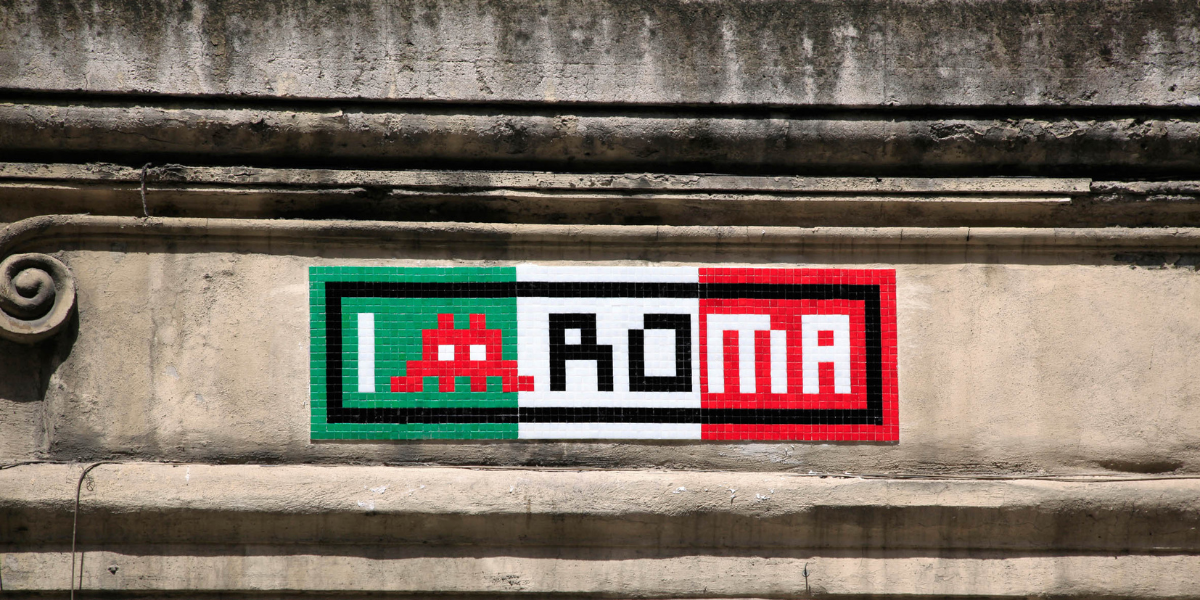
The 2010 invasion of Rome represents one of the most significant moments in Invader’s career. Intervening in a city with such dense historical layering means engaging with centuries of images, symbols, and architecture.
In Rome, Invader’s digital aesthetic merges with a monumental and complex context, creating an unexpected dialogue between the ancient and the contemporary. Pixels appear on millennial walls, video game-inspired figures coexist with Europe’s most iconic urban landscape. The city thus becomes a palimpsest, traversed by new layers of meaning.
Rome proves to be an ideal scenario: not only for its visual power but for its ability to embrace and absorb new signs without losing its identity.
Invasion of Roma: The Map as Artwork
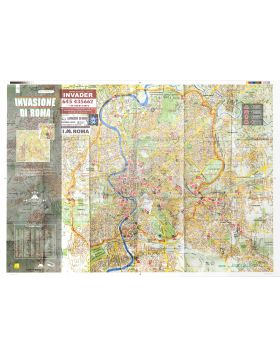
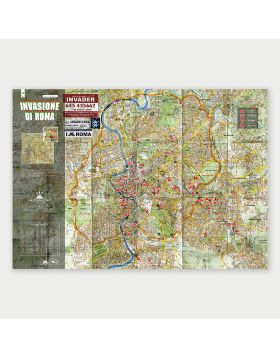
From this experience comes Invasion of Roma, a map documenting the artist’s interventions in the city. It is not simply a guide but a true visual object, capable of condensing the invasion into a tangible form.
The map traces locations, provides an overview, and allows the actions of Invader to be revisited even far from the urban space. It is both a document and an extension of the artwork: a way to transform a widespread, temporary experience into something lasting.
Through Invasion of Roma, the city becomes consultable, readable, collectible. The invasion continues—this time on paper.
Between Street Art, Collecting, and Urban Memory
Invader’s work constantly moves between the street and private spaces. The works are born in the urban context but find new forms of existence through maps, editions, and documents.
In this sense, Invader’s maps take on particular value: they are not only tools for orientation but archives of urban memory. They collect traces, record moments, and preserve interventions that may disappear or transform over time.
Collecting Invader’s work is not just about the object but the experience. Collecting means keeping a part of the city, a fragment of a larger project, a memory of an unexpected encounter in public space.
Following the Invasion
Invader invites us to see cities with new eyes, to rediscover familiar corners through the lens of art. His invasions transform urban space into a territory to explore, decode, and experience more consciously.
Invasion of Roma represents a natural extension of this experience: a way to follow the invasion, relive it, and carry it with you. Between map, memory, and collecting, Invader’s work continues to expand, reminding us that art can be everywhere—if we know how to look for it.