
 Register


2025 emerges as a year of normalisation and maturity for the contemporary art market. After the acceleration seen in the post-pandemic period, the auction system is consolidating new balances: values are stabilising, market dynamics are becoming more selective and, above all, the factor that best measures the sector’s vitality today is gaining importance — the volume of transactions.
Between July 2024 and June 2025, the global contemporary art auction market reaches $1.44 billion, while the most dynamic momentum comes from the lower end of the market. Sales in the accessible segment continue to grow, with works priced under $5,000 driving exchanges and setting a new record for the fifth consecutive year.
This evolution reflects a market that is broadening and diversifying: less dependence on headline-making sales and greater focus on what builds value over time — continuity, recognisability and liquidity. In this context, Street Art and urban languages prove to be perfectly aligned with the present, capable of engaging a wide audience, operating across different price ranges and attracting collectors with diverse profiles and budgets.
Wunderkammern artists in the contemporary art market of 2025
Artists such as Invader, JonOne, Stik, Obey (Shepard Fairey) and Vhils, represented by Wunderkammern Gallery and cited in the Artprice 2025 Report, stand out for a solid and recognisable auction presence, supported by significant sales volumes that confirm their role within the international contemporary art landscape.
Invader: a market built on continuity
Invader stands out for a broad and well-structured market, based on the constant circulation of works. According to the report, his auction results generate a total auction value of $1,644,731, with 220 lots sold. The highest auction result reaches $141,115, but the most meaningful indicator remains the frequency of transactions.
This profile reflects an artist capable of sustaining long-term market attention, with demand distributed over time rather than driven by isolated peaks — an increasingly central feature of today’s contemporary art market.
JonOne and the strength of the secondary market
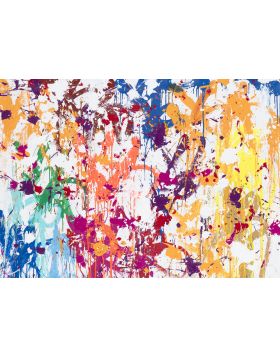
JonOne’s trajectory is defined by a strong sense of stability. In 2024/25, his auction sales amount to $642,894, built through 96 lots sold, with a best auction result of $53,537.
His presence in the report highlights a market that continues to move steadily, supported by collectors who recognise the stylistic continuity and expressive strength of his work.
Stik and the growing weight of the accessible market
Stik’s case is particularly emblematic of the direction the market is taking in 2025. His works generate an auction turnover of $367,066, with 113 lots sold, while the highest result reaches $52,003.
More than the single price point, what stands out is the number of works successfully placed on the market — a clear reflection of the growth of the accessible segment, now the true engine of global transactions.
Obey (Shepard Fairey): reach and recognisability
The market for Shepard Fairey, known as Obey, is characterised by exceptionally wide reach. During the period analysed, his works generate an auction value of $657,967, with 213 lots sold. The highest auction result reaches $32,500.
These figures describe a highly liquid market, fuelled by editions and works capable of engaging a broad international audience while maintaining strong visual and conceptual consistency.
Vhils and new collecting trajectories
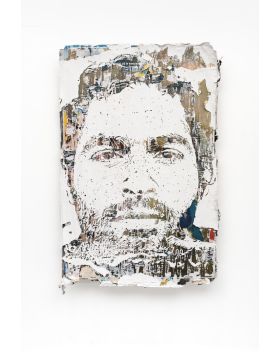
Vhils emerges in the report not only for his economic results, but also for his ability to interpret one of the most compelling trajectories of the current market: hybrid formats. In the period considered, his auction sales reach a total value of $259,996, with 51 lots sold and a best result of $32,211.
This is complemented by the sale of Detritus #3, presented as an NFT but sold together with a physical component — a print on a concrete block — and auctioned for $4,785 at Artcurial Paris on 6 November 2024.
In very concrete terms, this case demonstrates how the hybridisation between digital and physical — the so-called “phygital” dimension — is finding space within contemporary collecting, rewarding experimental practices that remain fully coherent with the artist’s identity.
A 2025 that rewards identity and recognisability
In 2025, the contemporary art market appears less focused on records and increasingly oriented towards models based on sustainability, continuity and accessibility. While the top end becomes more selective, the importance of artists capable of activating lively, distributed and recognisable markets over time continues to grow.
The data related to the artists represented by Wunderkammern Gallery clearly illustrate this balance between economic value, reach and identity, confirming Street Art and urban art not only as culturally central, but as increasingly structural components of the global contemporary art market.