
 Register

From Message to Structure
OBEY’s work has always been grounded in the message. A direct visual message, designed to capture attention, infiltrate public space, and provoke critical reflection on power, authority, and mass communication. Over time, this practice has evolved without losing coherence, shifting focus from urban intervention to an increasingly structured reflection on the image.
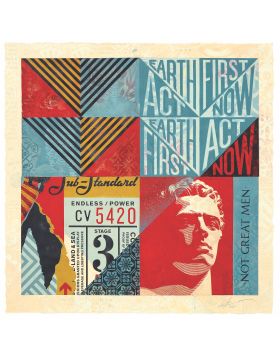
The Modular Discourse series represents a moment of particular formal and conceptual concentration. Here, OBEY does not abandon the political content of his language, but organizes it into a more rigorous, almost analytical system. From urban visual propaganda, the focus moves to an orderly construction of discourse, where every element is calibrated and controlled.
OBEY: Aesthetics and Control
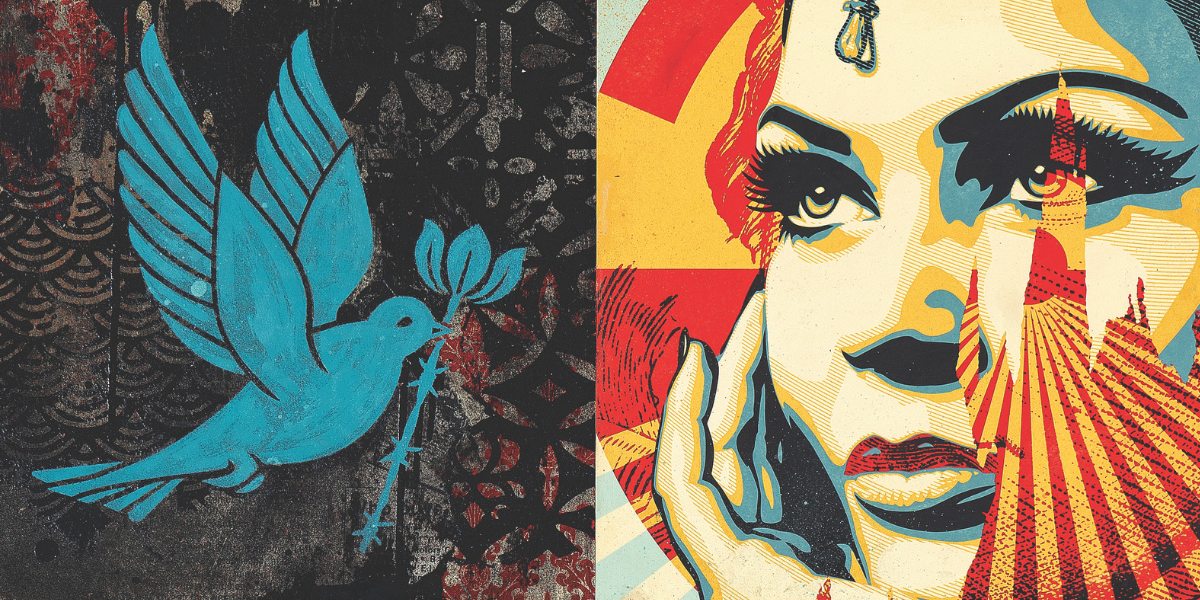
Posters, graphics, political iconography: OBEY’s language is born from the appropriation of visual communication codes. Bold colors, strong contrasts, symbolic figures, and concise slogans form a recognizable grammar, evoking both propaganda and graphic design.
At the core of this aesthetic lies a rigorous control of composition. Nothing is left to chance: every image is crafted to be immediate, legible, and impactful. This control is not only formal but conceptual. OBEY uses structural rigidity as a critical tool, making visible the very mechanism of persuasive communication.
What is Modular Discourse
Modular Discourse is a series of works built through repeated modules and compositional grids. The images do not function as isolated entities but as parts of a broader visual system. This is where the term “discourse” gains its meaning: it is not about individual statements but a structure that organizes and conveys meaning as a whole.
The module becomes the minimum unit of communication—not just a formal element, but a sign loaded with ideological implications. Repetition, order, and seriality transform the image into a device, recalling the processes through which power constructs and disseminates its messages.
Repetition, Power, Propaganda
Repetition is a fundamental tool of mass communication. Through reiteration, a message imprints itself on collective memory, becoming familiar, almost invisible. Modular Discourse works precisely on this mechanism.
The works present orderly surfaces and seemingly stable structures that conceal a critical tension. The reference to political propaganda is evident but not didactic: OBEY does not denounce through slogans but through the very form of the work. Order becomes ambivalent—both reassuring and unsettling—revealing the structural side of visual power.
Graphics, Art, and Space
OBEY’s work has always moved at the intersection of street art, graphic design, and contemporary art. Modular Discourse makes this dialogue particularly evident. The grid evokes posters, murals, and industrial printing; the modular composition recalls processes of serial production and large-scale dissemination.
In this series, urban space is translated into a more contained and controlled format. The visual dynamics of the street are distilled, concentrated, and made legible within a work that retains its communicative power even when the context changes.
From Public Space to Private Dimension
With Modular Discourse, OBEY makes a significant shift from public space to the realm of collection. The work does not lose its systemic character but becomes a fragment of a larger discourse that can be embraced in private space.
Collecting Modular Discourse does not mean choosing a decorative image but engaging with a structure of thought. The work demands attention, invites reading, and stimulates reflection beyond immediate impact. It is a conscious gesture, acknowledging the conceptual value of the series as a whole.
Reading the Message
Modular Discourse can be read as a synthesis of OBEY’s visual thought: a body of work combining formal rigor and critical depth, aesthetic control and political tension. It is a series that does not ask to be consumed quickly but observed, interpreted, and understood over time.
Through modules, grids, and repetitions, OBEY constructs a language reflecting on the very function of images in contemporary society. In this sense, Modular Discourse is not only a series of works but a privileged key to accessing his poetics.