

 Register

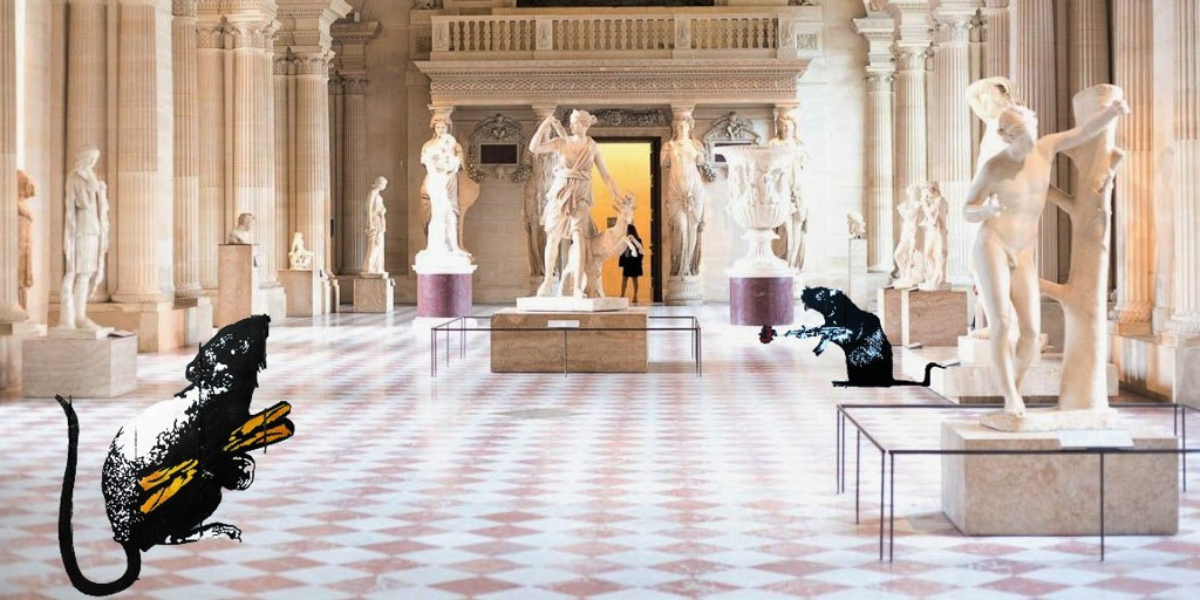
If there is one animal that perfectly embodies the spirit of urban art, it is the rat. Invisible yet omnipresent, nocturnal, resilient, capable of surviving in hostile environments and slipping into the cracks of the city, the rat has long been a recurring symbol for many street artists.
When these creatures even populate the halls of the Louvre, we are not merely witnessing a provocative gesture, but an act full of irony and reflection on the relationship between official and independent art.
The Rat as a Metaphor for the Urban Artist
The rat has no right of citizenship in places of prestige and power, yet it traverses them silently.
Similarly, the urban artist operates without permission, outside institutional frameworks, transforming walls, underpasses, and marginal spaces into improvised canvases.
Bringing rats into the Louvre therefore overturns hierarchies: what is marginal, clandestine, and uncelebrated takes over the very heart of official art.
Irony and Institutional Critique
The invasion of rats among the Louvre’s works is not an act of vandalism, but an ironic gesture that questions the very concept of museum sanctity. Why is one work deemed worthy of being inside a museum and another not?
The rat’s intrusion is a sharp reminder: art does not belong solely to monumental halls—it is born and lives also outside, in the streets and among the people.
From the Streets to Museums, and Back
In recent years, museums have increasingly opened their doors to urban art, recognizing its cultural and social value.
However, the image of rats in the Louvre reminds us that this art retains a rebellious, ironic vocation, capable of challenging the very institutions that now host it.
Irony thus becomes a critical tool, a way of restoring complexity to a language that cannot be fully contained within museum frames.
A Lesson from the Underground
The rat is a survivor, a dweller of the margins, an emblem of resilience. Transposed into the museum context, it becomes a symbol of artistic vitality that eludes control.
Its presence in the Louvre corridors is not only a provocation but also an invitation to rethink art as something alive, unrestricted, and constantly surprising.
Ultimately, the intrusion of rats into museums reminds us of a simple truth: urban art does not ask for permission. It enters spaces, traverses them, and transforms them, with the same persistence and underground energy with which rats inhabit cities.
It is an art that carries the power of the unexpected and the ability to overturn established perspectives.